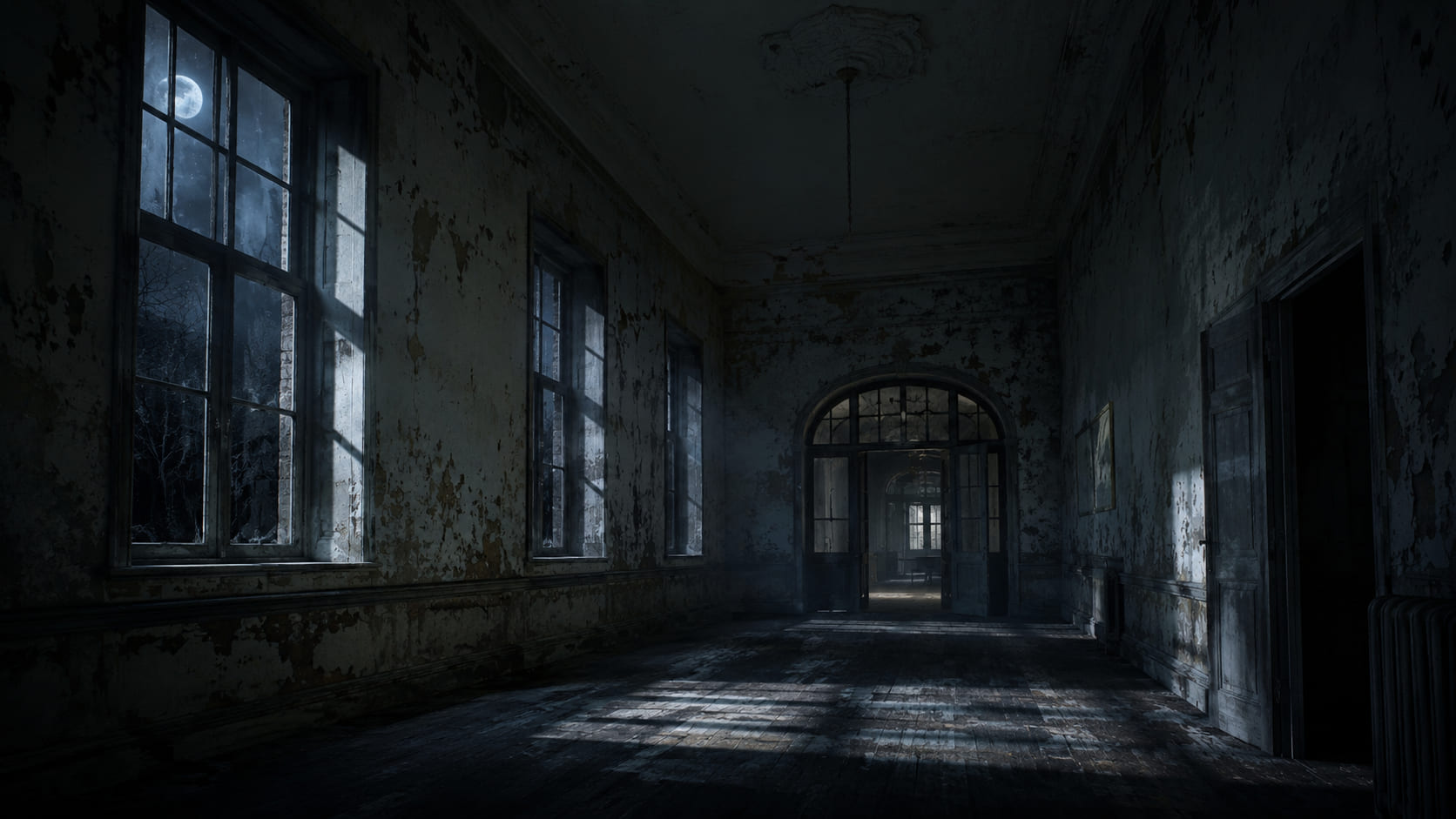
Why Do Old Buildings Feel Haunted?
Walk into an abandoned hospital, centuries-old inn, or empty manor house at night and the atmosphere can change before anything happens. Floors creak. Air moves through unseen gaps. Rooms smell different. Familiar sounds behave strangely. If the building already has a ghost story, every unusual sensation arrives with an explanation ready to attach itself.
Old buildings are ideal laboratories for understanding how environment, expectation, and perception interact. They can also contain genuine safety hazards. Before interpreting a headache, strange smell, sense of presence, or unusual sound as paranormal, investigators should understand what the building itself may be doing.
Architecture changes the way we hear
Large rooms create echoes and reflections that make sound difficult to locate. Thick walls can carry vibrations from distant sources. Pipes transmit knocks through several floors. Heating systems expand and contract. Animals move inside walls and roofs.
A noise that disappears into daytime traffic can seem loud and isolated at 02:00. Humans are uncomfortable with sounds they cannot locate, so the brain searches for a source.
This is one reason repeated “footsteps” should be tested over time. Do they happen when heating switches on? When a nearby train passes? When temperature changes? A pattern can feel supernatural until the environmental cycle becomes visible.
Low light turns ordinary objects into uncertain shapes
Human vision is less detailed in darkness. Peripheral vision is particularly sensitive to movement but poor at fine detail and color. A hanging coat, mirror reflection, open doorway, or moving branch can become a figure for a fraction of a second.
Expectation matters. Tell visitors that a staircase is haunted by a woman in white and ambiguous visual information now has a template. A pale reflection is no longer just a pale reflection; it has a possible identity.
This does not mean witnesses are dishonest. Perception is interpretation. The brain makes rapid predictions from incomplete sensory information, and sometimes the prediction wins.
Infrasound may contribute to an uneasy atmosphere
Very low-frequency sound can come from ventilation, machinery, traffic, and natural sources. Recent research has found that infrasound exposure can affect stress-related responses even when participants do not consciously hear it.
As explained in our guide to infrasound and haunted locations, this does not mean a hidden frequency generates ghosts. It does mean that an environment can influence mood and bodily state in ways a visitor may not immediately identify.
A person who becomes tense for an unknown reason may scan the environment more closely, increasing the chance that ambiguous sights and sounds feel threatening.
Air quality is not a paranormal detail
Old buildings can contain faulty heating systems, poor ventilation, mould, chemicals, and other hazards. Carbon monoxide deserves particular attention because it is colorless and odorless and can cause headache, dizziness, weakness, nausea, chest pain, and confusion. Severe exposure can be fatal.
The US Centers for Disease Control and Prevention advises treating carbon monoxide as a serious health risk. If several people in a building develop unexplained symptoms, especially around fuel-burning equipment, the priority is safety and professional assessment, not paranormal experimentation.
A frequently cited 1921 medical case connected strange experiences in a supposedly haunted home with carbon monoxide exposure from a faulty furnace. Historical cases should not be used to claim that carbon monoxide explains all hauntings, but they demonstrate why environmental checks matter.
History changes perception before you enter
A building's reputation can be as influential as its architecture. Once visitors know that a murder, death, or alleged apparition is associated with a room, ordinary sensations are interpreted through that story.
Researchers call this expectation or priming. It can influence what people notice, how they describe it, and what they remember afterward. A strong investigation therefore collects impressions before revealing the full legend whenever possible.
Historical claims should also be verified. Haunted-location stories often grow through repetition. A supposed Victorian tragedy may turn out to have no documentary basis, while a real death may have occurred in a different room or decade. Correcting the history does not destroy the mystery. It prevents folklore from being presented as fact.
Old buildings also carry emotional signals
Peeling paint, narrow corridors, damaged furniture, silence, and signs of abandonment suggest danger or neglect. Humans read environments socially. A place that appears uncared for can feel less safe even when there is no immediate threat.
Some architectural spaces also limit escape routes or visibility. Long corridors, blind corners, basements, and rooms with only one exit can increase vigilance. Horror filmmakers use these features because they already affect us psychologically.
The result is a powerful feedback loop. The building creates uncertainty. The ghost story provides an explanation. Increased attention makes more anomalies noticeable. Each anomaly strengthens the expectation.
A practical checklist before calling a building haunted
Start with safety. Confirm structural stability, legal access, working carbon monoxide detection where relevant, and any risks from electricity, asbestos, mould, or unstable floors. Paranormal curiosity is not a reason to enter unsafe property.
Next, document environmental cycles. Record temperature, weather, heating, ventilation, traffic, nearby occupants, and animal activity. Use continuous audio and video rather than recording only after someone reports something.
Finally, separate history from legend and witness reports from interpretation. “A door closed at 23:14” is an observation. “A former resident closed the door” is a conclusion requiring additional evidence.
Feeling haunted is real even when the cause is ordinary
Old buildings can be genuinely uncanny. Their acoustics, darkness, physical deterioration, histories, and unfamiliar layouts create conditions that modern daily life rarely provides. That atmosphere deserves study without being confused with proof of spirits.
The Stone Tape theory imagines that buildings literally preserve past events. The better-supported reality may be subtler: buildings preserve physical traces, stories, sounds, risks, and expectations that shape what living people experience inside them.
Sometimes an investigation will identify the source of a mystery. Sometimes it will not. The important step is to test what can be tested before turning an unknown into an answer.