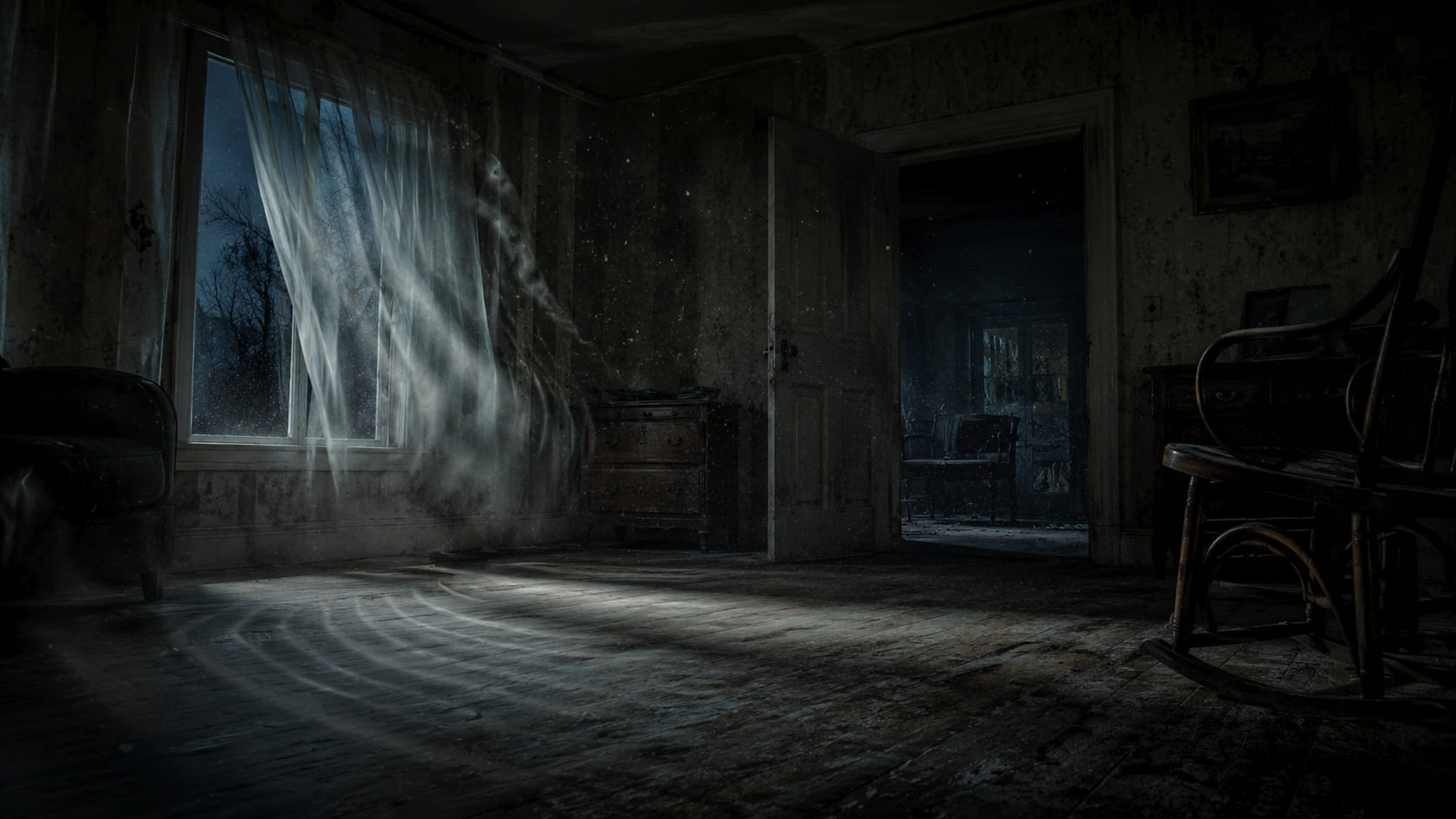
Haunted Houses and Infrasound: Can Low Frequencies Create a Sense of Presence?
Some places feel wrong before anything obviously strange happens. Visitors describe pressure, unease, chills, dread, or the sensation that someone else is in the room. In a building already rumored to be haunted, those feelings can quickly become part of a paranormal interpretation.
One proposed environmental factor is infrasound: very low-frequency sound below the range normally described as human hearing. The idea has circulated in paranormal research for decades, often with stronger claims than the evidence supports. Recent research, however, gives the subject a clearer and more interesting basis.
What infrasound actually is
Sound frequency is measured in hertz. Human hearing is often described as extending down to roughly 20 Hz, although sensitivity varies and very intense low-frequency vibrations may be sensed in other ways. Infrasound can come from natural sources such as storms and from human-made sources including machinery, ventilation systems, traffic, and industrial equipment.
Because a person may not consciously identify the sound, it is tempting to imagine that infrasound could influence mood while remaining unnoticed. That possibility has made it especially attractive as an explanation for “haunted” environments.
The famous laboratory story behind the theory
Engineer Vic Tandy became closely associated with the infrasound-haunting idea after reporting unusual experiences in a laboratory and later identifying a low-frequency vibration in the environment. His work helped popularize the suggestion that certain frequencies might contribute to feelings of unease or unusual visual experiences.
The story has often been repeated as though scientists proved that a specific frequency creates ghosts. They did not. Tandy's observations were interesting, but later controlled studies produced mixed results, and expectation itself can influence what people report in supposedly haunted settings.
A 2020 academic review of environmental research in “haunted houses,” available through the US National Library of Medicine, discusses a range of possible factors, including sound, electromagnetic conditions, air quality, temperature, and psychological expectation. The evidence does not support one universal environmental cause of hauntings.
What changed with the 2026 infrasound study
Research published in Frontiers in Behavioral Neuroscience in 2026 reported measurable effects from 18 Hz infrasound exposure. Participants did not consciously detect the infrasound, yet exposure was associated with elevated cortisol and more negative self-reported responses.
This is important because it supports a limited claim: low-frequency sound can influence human stress responses and mood even when people do not clearly hear it. It does not demonstrate that infrasound causes apparitions, voices, or complete haunting experiences.
That distinction matters. A person who enters a building and becomes inexplicably tense may become more alert to every creak and shadow. Increased stress can change attention and interpretation. Infrasound might therefore contribute to the conditions in which a haunting is perceived without generating a detailed ghost by itself.
A haunted feeling can have several causes at once
Real environments are messy. An old cellar may contain low light, unfamiliar acoustics, cold air movement, mouldy smells, distant traffic vibration, and a story about a death that supposedly occurred there. A visitor may already expect something unusual.
These factors can interact. The brain does not label them separately. It produces an overall experience: this place feels threatening. Once that feeling appears, ambiguous events can take on greater significance.
This is why environmental investigation should not search for one magical “ghost frequency.” It should document multiple conditions and compare supposedly active areas with control areas. A sound measurement is most useful when investigators know whether the same frequency appears elsewhere in the building.
How to investigate low-frequency sound responsibly
Ordinary phone microphones are not reliable instruments for all low-frequency measurements. Serious testing requires equipment capable of accurately recording the relevant frequencies, together with calibration and knowledge of the background noise.
Investigators should record machinery cycles, ventilation changes, nearby roads, weather, and building occupancy. Measurements should be taken over time rather than during one dramatic moment. If unusual sensations occur, note their exact location and time before checking the data.
Most importantly, do not tell participants that a particular room contains infrasound before asking how they feel. Expectation can contaminate the result. A better design compares reports from people who do not know which environmental conditions are present.
Infrasound is a plausible factor, not a universal answer
The strongest current evidence supports a modest conclusion. Infrasound can affect people, including measurable stress-related responses under experimental conditions. Some allegedly haunted places may contain low-frequency sources. It is therefore reasonable to consider infrasound during environmental investigations.
But a low-frequency reading does not explain every report in a building, and the absence of infrasound does not make a paranormal explanation correct. The same caution applies to unexplained audio recordings: identifying an anomaly is only the beginning of an investigation.
A grounded paranormal inquiry asks what physical conditions were present, what people expected, what they actually experienced, and what can be reproduced. Infrasound belongs in that toolkit because it is real, measurable, and capable of affecting us. That makes it more interesting, not less, even when no ghost is required.