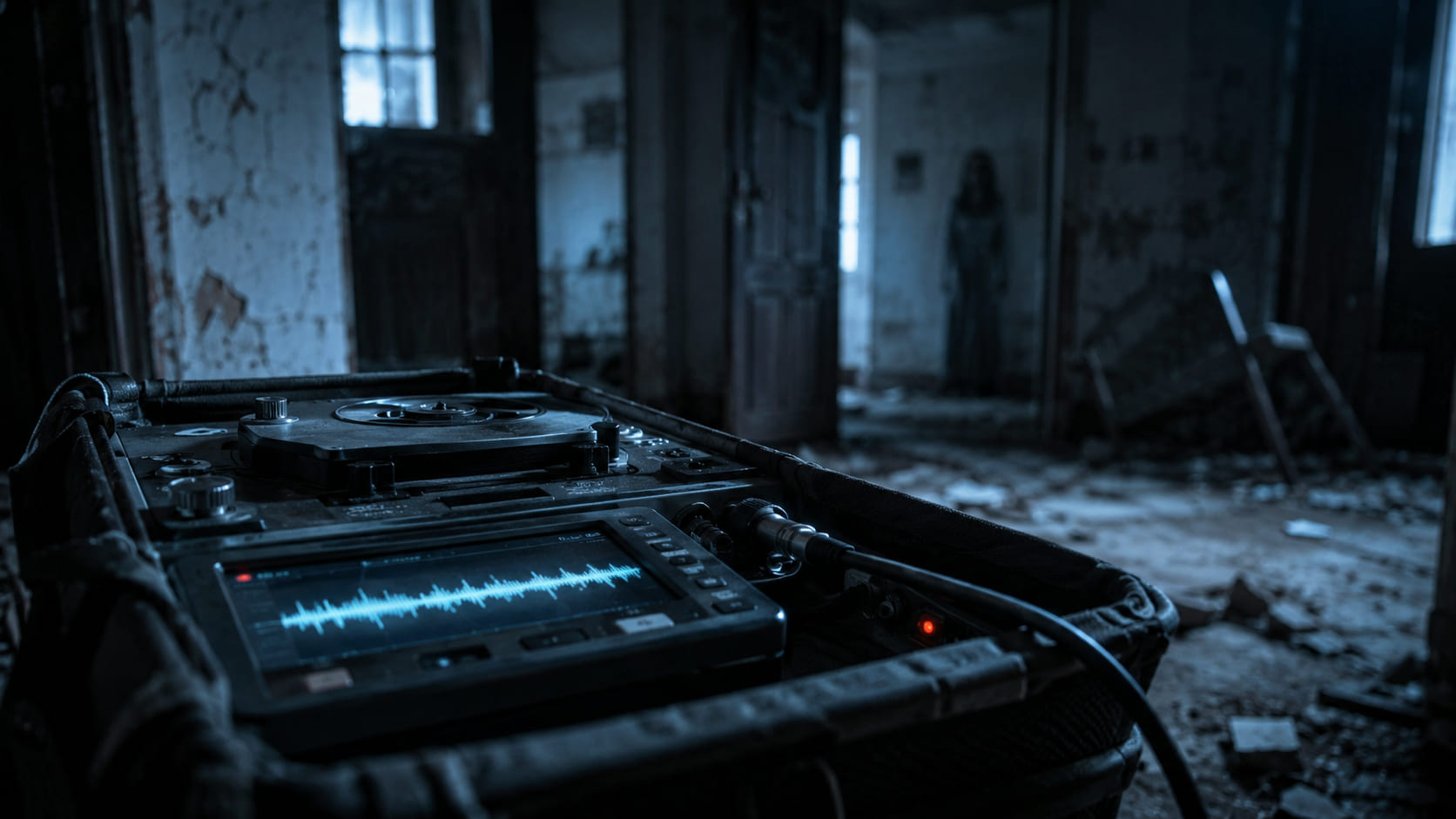
Electronic Voice Phenomena: What Are EVP Recordings Really Capturing?
A recorder is left running in an empty room. When the audio is played back, someone hears a whisper that nobody noticed at the time. One listener hears a name. Another hears a warning. A third hears only static. This is the basic pattern behind electronic voice phenomena, usually shortened to EVP.
EVP has become a standard feature of paranormal investigation, but the phenomenon is harder to evaluate than television often suggests. Recordings can contain real unexplained sounds without proving that the source is a spirit. Microphones capture more than human ears notice, digital processing can change ambiguous audio, and expectation can strongly influence what listeners believe they hear.
What investigators mean by EVP
In paranormal practice, an EVP is generally a voice-like sound found on a recording that was not recognized as ordinary speech when it was recorded. Some investigators ask questions and leave silent gaps for responses. Others record continuously in reportedly haunted locations and review the audio later.
The concept became widely associated with twentieth-century experimenters including Friedrich Jürgenson and Konstantīns Raudive, who interpreted voice-like sounds on recordings as communications from the dead. Later ghost-hunting culture adopted portable digital recorders and made EVP sessions one of its most accessible methods.
The first problem is ordinary sound
A quiet building is rarely silent. Pipes expand. Refrigerators cycle. Wood shifts. Clothing rubs against microphones. People speak outside. Radio transmissions and electronic interference can contaminate equipment. An investigator may whisper without realizing how clearly the recorder captured it.
Microphones also hear differently from humans. A sound that seemed too faint to notice during an investigation can become obvious through headphones. Direction is difficult to judge from a single microphone, so a distant ordinary voice can sound as though it came from inside the room.
This is why careful recording requires more than placing one device on a table. Investigators should synchronize multiple recorders, log every movement and spoken word, avoid whispering, and preserve the original unedited files. A sound appearing on several devices at different levels may provide clues about where it originated.
Auditory pareidolia can turn noise into language
The human brain constantly searches for meaningful patterns. Auditory pareidolia occurs when ambiguous sound is interpreted as a recognizable voice, word, or phrase. This is especially likely when listeners already expect speech.
Research published in PLOS ONE has examined how priming can influence the perception of illusory words in ambiguous sound. The broader lesson is directly relevant to EVP review: telling someone what a recording supposedly says can change what they hear.
Try listening to an unclear clip before reading a suggested transcript. You may hear nothing definite. Read the phrase and play it again, and suddenly the words appear obvious. The audio has not changed. Your brain's interpretation has.
Audio enhancement can create new uncertainty
Investigators often amplify, filter, slow, isolate, or reduce noise to make a suspected EVP clearer. Some processing is legitimate, but every transformation needs to be documented. Aggressive filtering can remove frequencies, emphasize artifacts, or make random fluctuations sound more speech-like.
The strongest practice is to keep the untouched original and provide the exact processing steps used to create any enhanced version. A listener should be able to compare both. If a supposed sentence appears only after extensive manipulation, confidence should decrease rather than increase.
This connects with a broader lesson from paranormal evidence: the farther evidence moves from its original form, the harder it becomes to evaluate. A copied clip with no recording date, device information, full session audio, or chain of custody may be entertaining, but it has little investigative value.
What would make an EVP genuinely interesting?
An unexplained voice-like sound becomes more significant when ordinary contamination is tightly controlled. For example, multiple synchronized devices could capture the same apparent phrase, while continuous video confirms that nobody nearby spoke. Independent listeners could transcribe the clip without being shown suggested words. Their interpretations could then be compared.
Specific information would matter too. A vague sound interpreted as “leave” is easier to produce accidentally than a clear, contextually appropriate sentence containing verifiable information unknown to the investigators. Even then, researchers would need to rule out prior knowledge, hidden speakers, radio sources, editing, and fraud.
That standard may sound demanding, but extraordinary interpretations require strong evidence. An unexplained sound is evidence of an unidentified sound, not automatically evidence of a dead speaker.
How to run a cleaner EVP session
Start by documenting the environment. Record the room before asking questions. Note nearby roads, heating systems, radios, open windows, other people, and any equipment producing noise. Use more than one recorder if possible, placed apart from each other.
During the session, speak normally and announce every movement. If someone coughs, shifts a chair, or walks across the room, say so aloud. Avoid whispering because whispers are easily mistaken for mysterious voices later. Do not review only short selected clips; keep enough audio before and after the event to provide context.
When analyzing, listen first without a suggested transcript. Ask several people to write down what they hear independently. Agreement on a clear phrase is more interesting than a collection of completely different interpretations.
EVP remains a question of evidence quality
People do capture sounds they cannot immediately explain. That fact does not need to be denied. The problem begins when “unexplained” is treated as a synonym for “paranormal.” Recording artifacts, distant voices, environmental sounds, unnoticed speech, radio interference, and auditory pareidolia can all create compelling results.
The best EVP investigation therefore tries to disprove its own favorite recording. That may seem less exciting than declaring contact with the dead, but it produces stronger evidence. A clip that survives careful attempts at ordinary explanation is more interesting than one protected from scrutiny.
For a site concerned with psychical research, EVP offers a useful test of method. Curiosity asks us to listen. Skepticism asks us to control the conditions. Good investigation requires both.