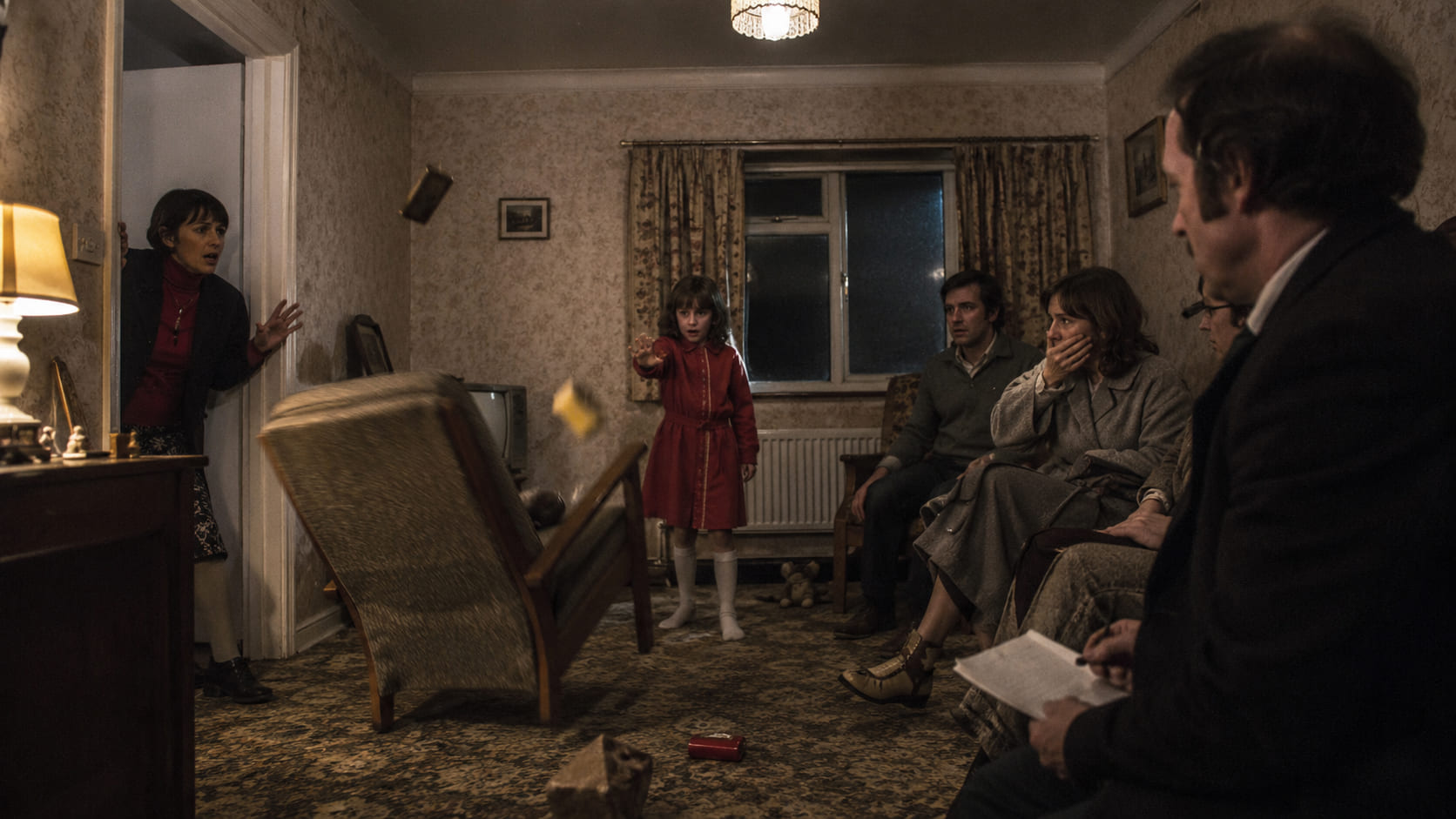
The Enfield Poltergeist: What Actually Happened?
Few alleged hauntings have generated as much argument as the Enfield poltergeist. Beginning in 1977 in a council house in Enfield, north London, the case involved reports of knocking sounds, moving furniture, thrown objects, strange voices, and apparent levitation. Journalists, police, neighbors, and members of the Society for Psychical Research became involved.
The case is often presented in two incompatible ways: either as one of the best-documented hauntings in history or as an obvious children's hoax. The surviving record is more complicated. Some incidents had multiple witnesses. Some were clearly vulnerable to trickery. The children were caught producing at least some phenomena. That combination is exactly why the case remains worth examining.
How the disturbances began
The events centered on the Hodgson family at 284 Green Street. In August 1977, the family reported unusual noises and furniture movement. Police were called, and one officer later described seeing a chair wobble and slide, although she could not determine the cause.
As publicity grew, the Daily Mirror became involved and the Society for Psychical Research sent investigator Maurice Grosse. Guy Lyon Playfair later joined the investigation. Reports expanded to include objects moving, knocking sounds, a rough voice speaking through 11-year-old Janet Hodgson, and photographs that appeared to show her airborne above a bed.
The BBC has preserved interviews and reporting connected with the case, and it has since inspired documentaries, books, dramas, and horror films.
The evidence that impressed believers
Supporters emphasize the number of witnesses. Neighbors, journalists, investigators, and a police officer reportedly observed unusual events. Recordings preserve the strange voice associated with Janet. Photographs show her apparently in midair. Grosse and Playfair spent extensive time with the family and believed that some events could not be explained by ordinary trickery.
This is a reasonable point in principle. Evidence of one false event does not logically prove that every event is false. But it does change the standard. Once deception is demonstrated, investigators must apply much stronger controls to later claims.
The problems are substantial
Skeptics have pointed out that many of the most dramatic events occurred in uncontrolled domestic conditions. Children and observers moved around freely. Objects could be thrown from outside the camera frame. Photographs of Janet “levitating” can also be interpreted as images of a child jumping from a bed.
Janet and her sister admitted to faking some incidents, although Janet later maintained that most events were genuine. Investigators themselves sometimes suspected trickery. Critics also argued that the deep voice attributed to a dead man could have been produced by Janet using unusual vocal techniques.
The central difficulty is therefore not the absence of reports. It is the lack of decisive controls around the strongest claims. A dramatic event witnessed in a crowded room is not equivalent to the same event recorded continuously from multiple angles under conditions that prevent normal interference.
Why multiple witnesses do not automatically settle it
Witness quantity is important, but witnesses are not independent measuring instruments. People discuss events. One person reacts, directing everyone else's attention. A sound heard after someone shouts “there it is again” may be interpreted differently than the same sound in a neutral setting.
Memory also changes through retelling. Over a long investigation, a household, journalists, and researchers can develop a shared narrative. This does not mean witnesses are lying. It means that later accounts should not be treated as untouched copies of what each person originally perceived.
The issue becomes especially important in a famous case because television adaptations and later books can feed details back into public memory.
The Enfield voice remains one of the strangest elements
Audio recordings of the rough voice associated with Janet are undeniably unusual to hear. The voice claimed to represent a man named Bill and became one of the most memorable parts of the case.
However, unusual does not mean impossible to produce naturally. Skeptical investigators argued that Janet could generate the voice herself. The evidential question is not whether the recording sounds eerie but whether the source was independently shown to be external to her.
This is similar to the challenge discussed in our article on EVP recordings. A voice-like sound needs a verified source analysis before its identity can be established.
What the case teaches investigators
The Enfield case demonstrates why paranormal investigation needs procedures established before dramatic events occur. Cameras should cover the whole room continuously. Objects should be marked and tracked. Witnesses should write independent accounts before discussion. Investigators should record failed sessions as carefully as successful ones.
Children require particular care. They may be frightened, playful, seeking attention, responding to adult expectations, or some combination of these. Treating a child as the center of a supernatural battle can itself influence behavior.
The Philip experiment provides a different example of how expectation and group dynamics can create meaningful patterns. Enfield shows how much harder those effects become to separate from possible anomalies in an uncontrolled home.
So what actually happened?
We can say with confidence that the Hodgson family became the center of a major public paranormal case and that numerous people reported unusual events. We can also say that at least some incidents were faked or suspected of being faked, and that many dramatic claims were not captured under conditions strong enough to eliminate ordinary explanations.
What we cannot honestly say is that every event has been conclusively explained, or that the case proves a poltergeist existed. The surviving evidence supports neither extreme with certainty.
Enfield remains compelling because it contains the ingredients that make real-world paranormal cases difficult: sincere witnesses, media attention, possible deception, ambiguous recordings, emotionally charged children, committed investigators, and events that rarely cooperate with controlled observation.
The best conclusion is therefore narrower than the legend. Something unusual was experienced and reported in Enfield. Some of it was demonstrably human-made. The rest remains a collection of claims of varying quality, not a solved case for either side.