The Philip Experiment: Can a Group Create a Ghost?
In the early 1970s, a group in Toronto attempted one of the strangest experiments in modern psychical research. Instead of trying to contact a known dead person, they invented one. They created a fictional seventeenth-century Englishman named Philip Aylesford, wrote a dramatic biography for him, imagined his appearance, and then attempted to communicate with him in séance-style sessions.
The story became famous because the group later reported table movements, knocks, and responses that appeared to correspond with questions about Philip. If Philip had never existed, what exactly was answering?
Building a ghost from nothing
The project was associated with the Toronto Society for Psychical Research and a group led by A. R. George Owen. The participants deliberately constructed Philip's identity. His biography included a troubled marriage, a romantic affair, accusations of witchcraft, and a tragic death. The story contained historical inconsistencies, helping ensure that Philip was a fictional creation rather than an accidentally rediscovered person.
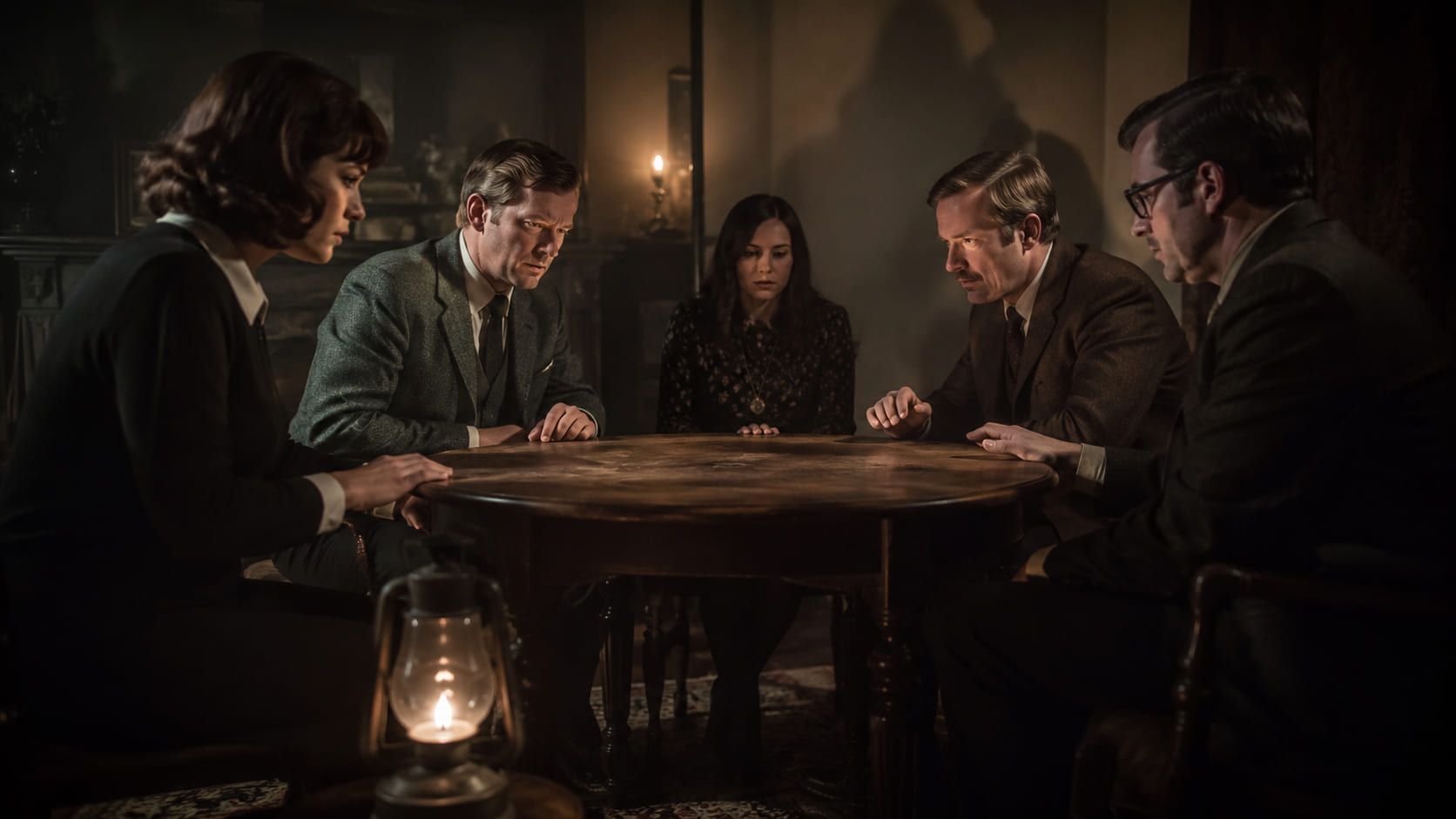
The initial sessions reportedly produced little. The group then adopted a more traditional séance atmosphere, sitting around a table and creating a more relaxed, expectant setting. They eventually reported raps and movements that seemed to answer questions.
Accounts of the Philip experiment remain popular because the setup creates an immediate puzzle. A fictional personality apparently behaved like a communicating spirit.
The spiritual interpretation has an obvious problem
If the reported phenomena were genuine, conventional spirit communication becomes difficult to apply. Philip was invented. There should have been no deceased Philip Aylesford available to answer.
Believers could argue that another entity adopted the fictional identity, but that explanation becomes impossible to test. Any contradictory response could be blamed on a deceptive spirit. A theory that can explain every possible result risks explaining nothing.
The experiment was therefore more naturally interpreted by some participants as a test of psychokinesis or group-generated phenomena. In this model, the people around the table produced the effects unconsciously and then organized them around the character they had created.
The ideomotor effect offers a simpler possibility
Table movement does not require deliberate fraud. The ideomotor effect describes small unconscious muscular movements influenced by expectation, thought, or suggestion. It is well known in practices involving Ouija boards, pendulums, and similar devices.
A group can sincerely believe nobody is pushing while many participants make tiny movements. Those movements combine, the table shifts, excitement increases, and the group becomes even more attentive to meaningful patterns. Knocks can then be counted as yes-or-no answers, allowing an improvised personality to emerge.
This does not prove that every event reported in the Philip sessions was ideomotor. It does show why controlled conditions are necessary. If participants are physically touching the table, movement alone cannot establish an unknown force.
How a fictional personality can become surprisingly consistent
Groups are good at collaborative storytelling even when they are not consciously trying to write a story. Once Philip's biography was memorized, participants shared the same expectations. Questions naturally focused on the same themes. Ambiguous responses could be interpreted within the known narrative.
Over time, this creates continuity. A knock in response to a question about Philip's fictional lover may feel like new information even if the participants already know which answers fit the story. Selective memory can further strengthen consistency because successful responses are remembered more clearly than failed or contradictory ones.
The process resembles the way a fictional character can feel psychologically real to a novelist or role-playing group. That does not make the character externally alive. It demonstrates the mind's ability to maintain coherent social models.
Why the experiment still matters to psychical research
The Philip experiment is often presented as proof of either paranormal group psychokinesis or the power of suggestion. The historical record does not justify such certainty. The sessions did not provide the kind of tightly controlled, independently replicated evidence needed to establish a new physical effect.
Yet the experiment remains conceptually valuable. It asks researchers to separate the apparent personality of a communication from evidence that the personality exists independently. The same issue appears in séances, Ouija sessions, automatic writing, and some EVP interpretations.
A message can sound intelligent without proving its claimed source. Before asking who is communicating, investigators need to establish that information or movement cannot be explained by the people already present.
How a stronger version could be tested
A modern experiment would require much tighter controls. Table movement could be measured with force sensors and motion tracking. Participants could be separated from direct contact under some conditions. Question sets could include information unknown to the sitters. Sessions could be preregistered so that researchers cannot change scoring rules after seeing the results.
Independent teams would also need to reproduce any effect. A single group generating unusual table movement is interesting. Multiple laboratories repeatedly producing the same measurable anomaly under controlled conditions would be far more significant.
Blind judging would help too. Instead of deciding during the session whether a knock “fits” Philip, independent evaluators could compare responses against several possible fictional biographies.
Did the group create a ghost?
The evidence does not establish that the Philip group created an independent spirit. It also does not require anyone involved to have been knowingly dishonest. Social expectation, unconscious movement, selective attention, and collaborative meaning-making can produce remarkable experiences.
That may be the most interesting lesson. People do not need to fake a séance for a fictional character to begin feeling present. Give a group a shared story, repeated ritual, ambiguous signals, and enough emotional investment, and something can emerge that seems larger than any one participant.
The Philip experiment therefore belongs in the history of psychical research not because it solved the mystery of ghosts, but because it exposed a deeper methodological problem: before interpreting an apparent intelligence, researchers must first understand how easily human groups can create one.