Shared Death Experiences: What Do Witnesses Report?
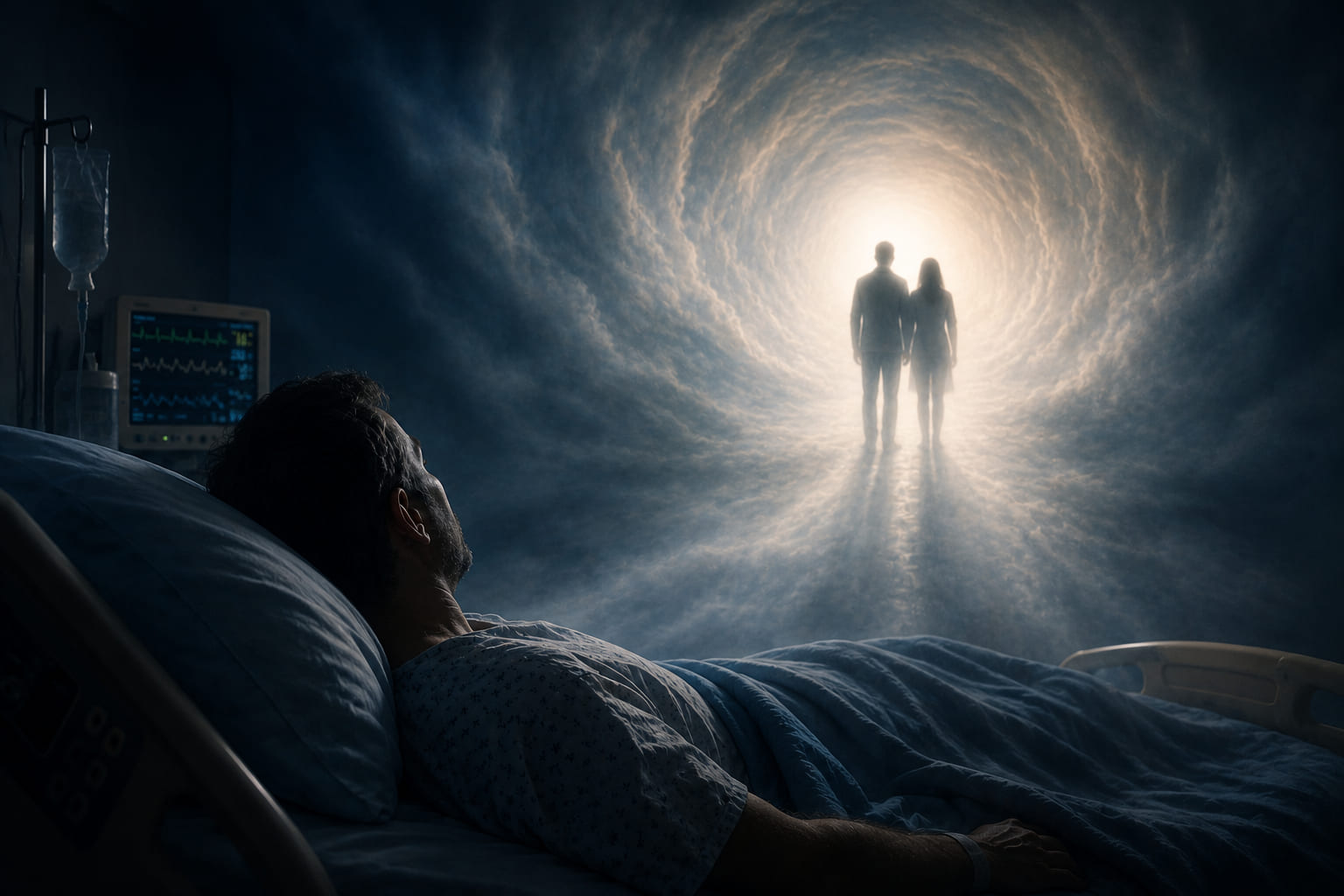
Near-death experiences are usually described by people who themselves came close to death. Shared death experiences are different. In these reports, a relative, caregiver, or other person near someone who is dying claims to experience part of the transition with them.
Accounts may include unusual light, a sense of leaving the body, vivid imagery, a feeling of accompanying the dying person, or suddenly knowing that someone has died at a distance. The subject sits at an uncomfortable boundary between end-of-life care, spiritual belief, bereavement, and psychical research.
There is no single shared-death experience
The term covers a wide range of reports. One person may describe a brief change in the atmosphere of a hospital room. Another may have a vivid vision. Someone else may report an experience while sleeping many kilometers away from the dying person.
Researchers therefore face an immediate classification problem. If every unusual event near a death is placed in one category, similarities can be exaggerated. A careful account should record what the witness actually perceived before assigning a label.
A 2021 paper indexed by PubMed described shared death experiences as a little-known category of end-of-life phenomena supported primarily by anecdotal reports. Later survey work has explored reports across several cultural groups, but the evidence remains largely retrospective.
The timing makes these experiences difficult to study
Researchers cannot ethically or practically create controlled deaths in a laboratory. Shared death experiences happen unpredictably, often during emotionally intense situations. Most studies therefore depend on people remembering and reporting events afterward.
That creates several challenges. Exact timing can be uncertain. A person may learn details about the death before being formally interviewed. Family members may discuss what happened and influence one another's memories. Dramatic experiences are more likely to be reported than uneventful ones.
These limitations do not prove the experiences are false. They limit what can be concluded from them.
End-of-life experiences are already a broader clinical subject
Hospice workers and families sometimes report visions, dreams, or unusual communications involving dying people. Research on end-of-life experiences attempts to document these events without assuming one explanation.
Some experiences occur in patients who are conscious and coherent. Others may happen alongside medication, sleep changes, delirium, metabolic disturbance, or neurological decline. The clinical context matters greatly.
For witnesses, exhaustion and anticipatory grief can also affect perception. Someone keeping vigil for many hours may move in and out of sleep without realizing it, creating conditions for extremely vivid imagery.
Why believers find the reports significant
The strongest paranormal interpretation is that consciousness may not be limited to an individual brain and that, near death, another person can temporarily share aspects of the dying person's experience.
Believers often point to reports in which the witness was not physically present or did not know that the person had died. Such cases resemble the older category of crisis apparitions and are potentially more evidential because they appear to involve information gained at an unusual time.
However, the evidential value depends on documentation. A written, time-stamped account made before the death is confirmed is stronger than a memory recorded months later. Researchers must also consider coincidence. In a large population, some people will have unusual dreams or sudden thoughts about loved ones near the time those people die purely by chance.
Meaning and proof are different questions
A shared death experience can profoundly affect a witness regardless of its cause. People may lose their fear of death, feel closer to the deceased, or reinterpret their spiritual beliefs. Those outcomes are psychologically and culturally important.
But a transformative effect does not establish an external mechanism. The same distinction applies to apparitions reported during bereavement. An experience can be sincere, vivid, and life-changing while its source remains uncertain.
This is where polarized discussion often fails. Dismissing a witness as delusional is unnecessary. Declaring the event proof of an afterlife is also unsupported without stronger evidence.
What better research would look like
Prospective research is difficult but possible. Hospices and palliative-care teams could use standardized questionnaires, with appropriate ethical oversight, to record unusual experiences soon after they occur. Researchers could distinguish firsthand perception from information learned later.
Exact timelines would be particularly valuable. Did the witness record the experience before receiving news? How precisely is the time of death known? Was the dying person conscious? What medications or medical conditions were involved? Were other witnesses present?
Cross-cultural studies can also help identify which features are widespread and which are shaped by local beliefs. If reports differ substantially between cultures, that may reveal how expectation influences interpretation. If highly specific features recur independently, researchers can investigate those patterns more closely.
How families and caregivers should approach these reports
There is rarely a need to argue with someone immediately about whether the experience was supernatural. A neutral response can acknowledge what they experienced without imposing an explanation.
In clinical settings, unusual perceptions should still be evaluated when they occur alongside confusion, distress, or possible medical problems. Respect for spiritual meaning and medical care are not mutually exclusive.
Researchers should also avoid exploiting grieving families. End-of-life experiences are emotionally sensitive material, not merely content for sensational stories.
What can we honestly conclude?
Shared death experiences are a real category of reported human experience, and researchers have begun documenting them systematically. Current evidence does not establish that one person's consciousness literally joins another during death. It also leaves important questions open because the events are difficult to capture prospectively.
The most responsible position is to preserve accurate reports, improve documentation, and separate experience from interpretation. That allows spiritual, psychological, neurological, and parapsychological hypotheses to be discussed without pretending any one of them has already won.
Death is one of the moments when human perception, emotion, memory, and meaning become most intense. Shared death experiences deserve serious attention precisely because of that complexity.