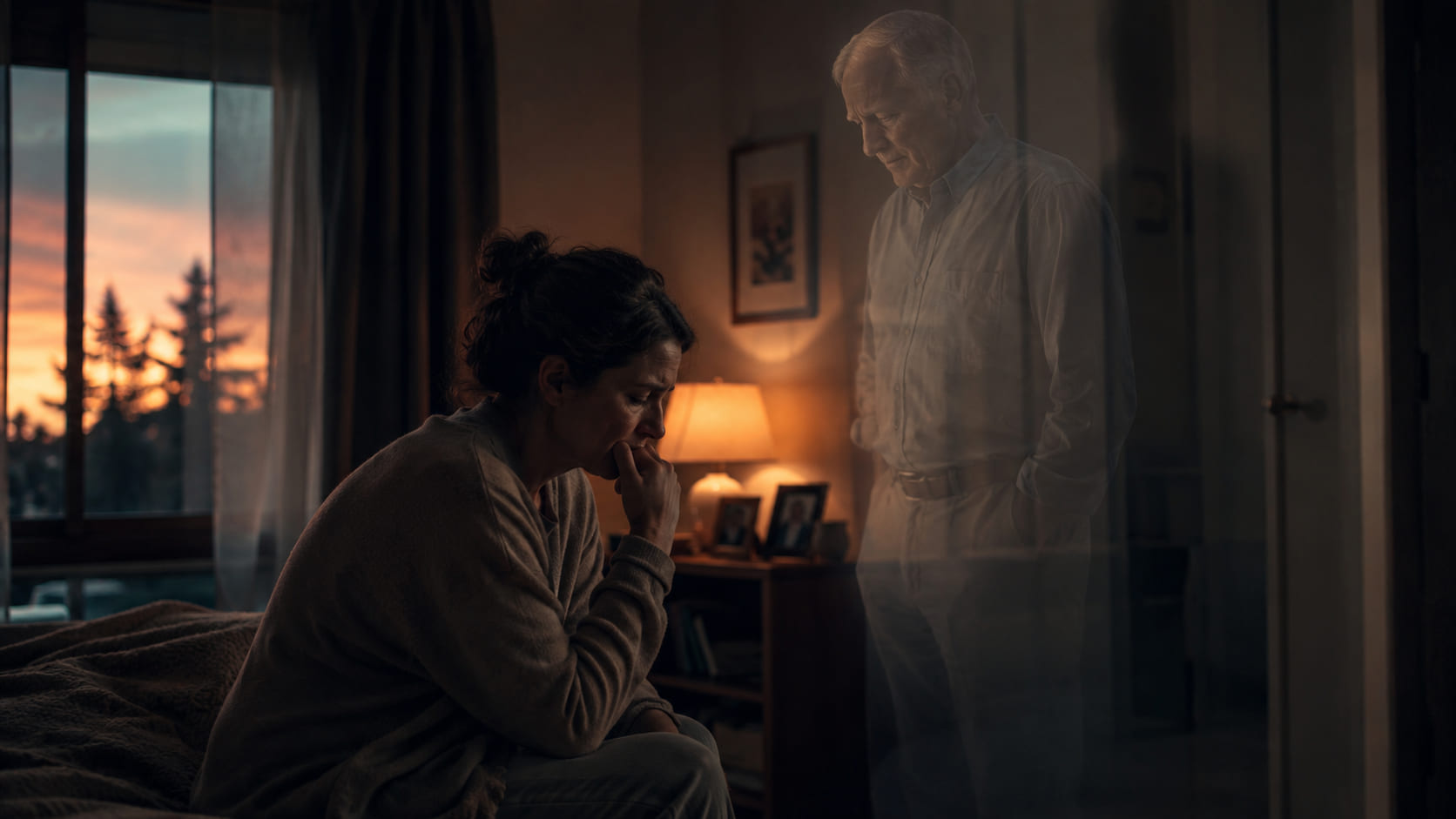
Why Do People See Ghosts During Grief?
Seeing a deceased loved one can feel like one of the most personal paranormal experiences imaginable. Some people report briefly seeing a familiar figure in a doorway. Others hear a voice, smell a distinctive perfume, feel someone sit on the bed, or simply experience an overwhelming sense that the person is nearby. These events are often called bereavement hallucinations, sensory experiences of the deceased, or after-death communications, depending on the researcher and the interpretation.
The word “hallucination” can sound alarming, but in this context it does not automatically imply mental illness. Research suggests that experiences involving deceased loved ones are relatively common among bereaved people and are often comforting rather than distressing. The difficult question is not whether people have these experiences. They clearly do. The question is how they should be understood.
The experience can involve more than vision
A ghost story usually emphasizes seeing an apparition, yet grief-related experiences are often less dramatic. A person may hear their name spoken in a familiar voice or wake from a vivid dream with an unusually strong sense of presence. Some report touch, smell, or a feeling that the deceased person has entered the room without any clear sensory image.
A 2019 systematic review and meta-analysis indexed by the US National Library of Medicine concluded that more than half of bereaved people may experience some form of bereavement hallucination, while also stressing important limitations in the available research. A later academic review of sensory and quasi-sensory experiences of the deceased found that the great majority appeared to be benign and should be understood within a person's relationship, biography, and cultural background.
This wide range matters. When someone says they “saw a ghost” after a death, the phrase may describe anything from a momentary visual impression to a vivid waking encounter. Treating every report as the same phenomenon makes serious discussion almost impossible.
Grief changes attention, expectation, and memory
After a major loss, the brain does not instantly update every habit built around the missing person. You may still expect to hear their key in the door, see them in a familiar chair, or receive a message at a certain time. For years, the person may have been part of thousands of daily predictions. Their absence is intellectually understood before it is fully integrated into automatic perception and routine.
This creates a plausible psychological framework for some experiences. A movement in peripheral vision can briefly become a familiar silhouette. A sound in another room can be interpreted as a known voice. A half-awake brain can combine memory and perception with unusual vividness. None of this means that the person is “making it up.” Perception is an active process, and the brain constantly interprets incomplete information.
Grief can also disturb sleep. Vivid dreams, hypnopompic imagery while waking, and sleep paralysis can produce realistic experiences that overlap with traditional ghost reports. When the person encountered is someone emotionally central, the experience can carry much more meaning than an ordinary dream.
Why the experience may feel completely real
People often assume that a mistaken perception should feel vague or uncertain. That is not how perception works. A brain-generated experience can feel immediate, detailed, and external. Dreams are an obvious example: while dreaming, most people do not continuously question whether the scene is real.
Does a psychological explanation settle the question?
Not completely. Psychology can describe mechanisms that could produce an experience without proving that every individual report has the same cause. At the same time, the existence of a powerful personal experience is not evidence by itself that a deceased person objectively appeared in the room.
A grounded approach separates three questions. First, did the person genuinely experience something? Second, what ordinary mechanisms could plausibly explain it? Third, is there independent evidence for a paranormal interpretation? The first can be answered yes without automatically answering the third.
Cases become more interesting to psychical researchers when they appear to include specific information the experiencer could not have known, especially if documented before confirmation. Even then, coincidence, forgotten prior knowledge, reporting errors, and later memory changes must be considered before making a stronger claim.
When an experience is comforting, and when to seek help
Many people describe these encounters as reassuring. They may feel that they had a chance to say goodbye or that the relationship continues in some form. Researchers studying bereavement increasingly recognize that maintaining an inner relationship with someone who died is not automatically unhealthy.
However, grief can also become overwhelming. The NHS guidance on bereavement recommends seeking support when grief, stress, anxiety, or depression is becoming difficult to manage. Repeated experiences that are frightening, disruptive, or accompanied by confusion in other areas of life deserve professional attention.
It is important not to use paranormal explanations to discourage someone from getting medical or psychological help. A person can respect the meaning of an experience while still checking for sleep problems, medication effects, neurological symptoms, or severe emotional distress.
A better way to talk about seeing the dead
The most useful response is neither “you definitely saw a spirit” nor “nothing happened.” Something did happen at the level of experience. The person saw, heard, felt, or sensed something memorable, often during one of the most emotionally intense periods of life.
Research gives us several credible mechanisms involving grief, expectation, sleep, perception, and memory. Spiritual and paranormal interpretations remain meaningful to many people, but they go beyond what the experience alone can establish.
That middle position can feel less dramatic, but it takes the witness more seriously. Grief-related apparitions are worth studying because they sit at the intersection of psychology, culture, memory, and the human relationship with death. Even without assuming a supernatural cause, they tell us something important about how the mind continues to represent people who are no longer physically present.