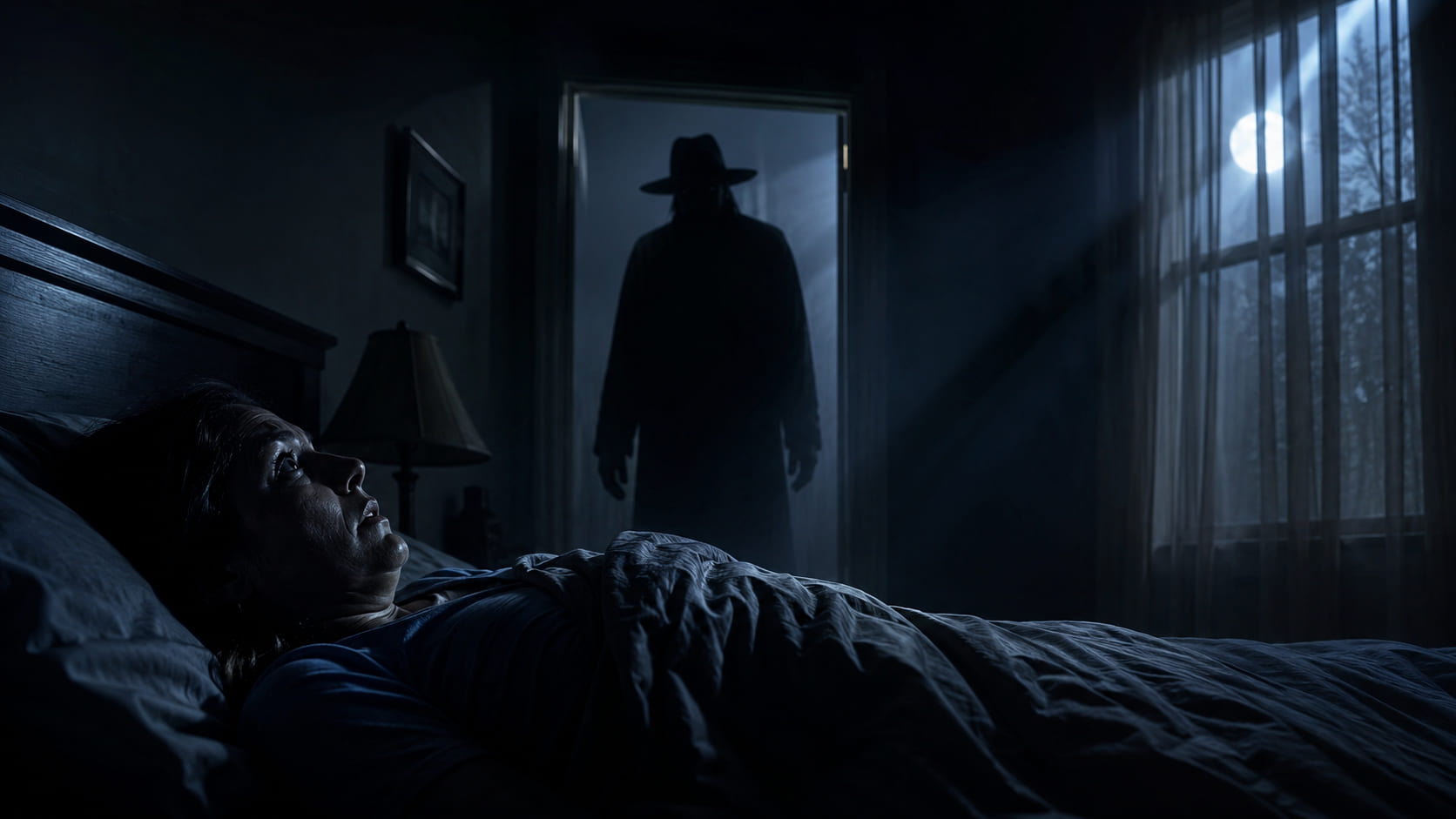
The Hat Man: Why Do People Report the Same Shadow Figure?
Among modern paranormal reports, few figures are as recognizable as the Hat Man: a dark human-shaped silhouette, often described as unusually tall and wearing a wide-brimmed hat. Reports circulate in sleep-paralysis communities, paranormal forums, podcasts, and personal stories. The striking similarity between accounts raises an obvious question. Why would unrelated people describe something that sounds so similar?
There are several possible answers, and they do not all require the same conclusion. Sleep paralysis can generate a powerful sense that an intruder is present. Human vision is extremely good at extracting person-like shapes from limited information. Cultural stories can influence how ambiguous experiences are remembered and described. At the same time, people who believe they encountered an external entity understandably point to recurring features as evidence that something more unusual may be happening.
Start with the state in which many sightings happen
Sleep paralysis occurs when awareness returns while the muscle paralysis associated with rapid eye movement sleep has not fully ended. The person may be awake enough to recognize the bedroom but temporarily unable to move or speak. The experience can also include vivid visual, auditory, and tactile hallucinations.
The Sleep Foundation describes “intruder hallucinations” in which a person perceives a threatening presence in the room, sometimes alongside chest pressure or a sensation of suffocation. These experiences can be extraordinarily convincing because dream imagery and waking perception overlap.
A dark bedroom provides exactly the kind of incomplete visual information that encourages the brain to fill gaps. A coat, doorway, chair, or shadow can become the outline of a person. During paralysis, fear may make the interpretation feel urgent and certain.
Why a human-shaped shadow appears so often
The brain is biased toward detecting agents. Missing a real person or predator can be costly, while briefly mistaking a shadow for one usually is not. In uncertain conditions, perception therefore tends to err on the side of finding meaningful forms.
Shadow figures are also visually economical. A detailed face requires much more sensory information than a silhouette. During a mixed sleep-wake state, the mind can construct a convincing “person” without supplying fine detail. This may help explain why many reports describe darkness where facial features should be.
The feeling of presence may come first, with the visual figure following. Someone wakes unable to move, feels watched, becomes frightened, scans the room, and then interprets a vague vertical shape as the source of the threat. The resulting memory is not necessarily experienced as a sequence of guesses. It can arrive as one immediate event: there is someone standing there.
So why the hat?
The hat is the most distinctive part of the legend, and there is no established scientific answer for why it appears in so many reports. Several possibilities deserve consideration.
First, wide-brimmed hats create a strong silhouette. A head-and-shoulders shape with a horizontal line is easy to recognize in low light. Second, dark hat-wearing figures are already familiar from fiction, historical clothing, film noir, Westerns, horror imagery, and older folklore. Third, once a named pattern becomes popular, people with vaguely similar memories gain a ready-made label.
The role of memory after a frightening encounter
Memory is not a video recording. Recalling an event involves reconstructing it, and later information can influence that reconstruction. Suppose someone remembers “a dark man-shaped figure near the door.” Months later, they encounter dozens of Hat Man stories. The original memory may remain sincere while becoming more specific in retelling.
This is especially relevant to paranormal research. Investigators should record a witness's first account before suggesting labels, showing images, or comparing it with famous cases. Asking “Did it look like the Hat Man?” is much more leading than asking “What did you see?”
Could every Hat Man report be sleep paralysis?
No. Some people describe seeing a similar figure while fully awake and moving normally. Others report childhood memories, sightings outdoors, or experiences shared with another person. Those cases need to be evaluated separately rather than forced into a sleep-paralysis explanation.
However, a report occurring during awakening, inability to move, chest pressure, intense fear, and a sensed intruder closely matches a well-documented sleep phenomenon. That explanation should be considered before assuming an external being was present.
The earlier article on apparitions during grief shows a similar principle: experiences can be genuine and emotionally powerful while still having plausible mechanisms rooted in perception, memory, and altered states.
How to document a recurring shadow-figure experience
If the experience happens repeatedly, record the circumstances immediately afterward. Note the time, sleep schedule, sleeping position, medication or substance use, stress level, lighting, and whether movement was possible. Describe the figure before searching for similar stories.
Repeated sleep paralysis can be associated with disrupted sleep and other sleep conditions. Keeping a regular sleep schedule may help some people, and persistent or severe episodes are worth discussing with a healthcare professional. A medical explanation should not be treated as an insult to the experience. It is simply one testable part of the investigation.
A shared image does not automatically mean a shared entity
The Hat Man is fascinating precisely because the reports sit between biology and folklore. Sleep paralysis provides a strong mechanism for the sensed intruder. Low-light perception can explain simplified human shapes. Culture can supply familiar visual features. Memory and online communities can strengthen similarities between stories.
None of these points proves that every report has been completely explained. They do show why repetition alone is not enough to establish a paranormal being. Humans share nervous systems, sleeping environments, fears, visual biases, and stories. Shared minds can produce shared patterns.
The most careful approach is to preserve the strange part without skipping the ordinary one. Record what happened first. Check the sleep context. Avoid leading labels. Then ask what remains unexplained. That method gives the experience a better chance of being understood, whatever its ultimate cause.