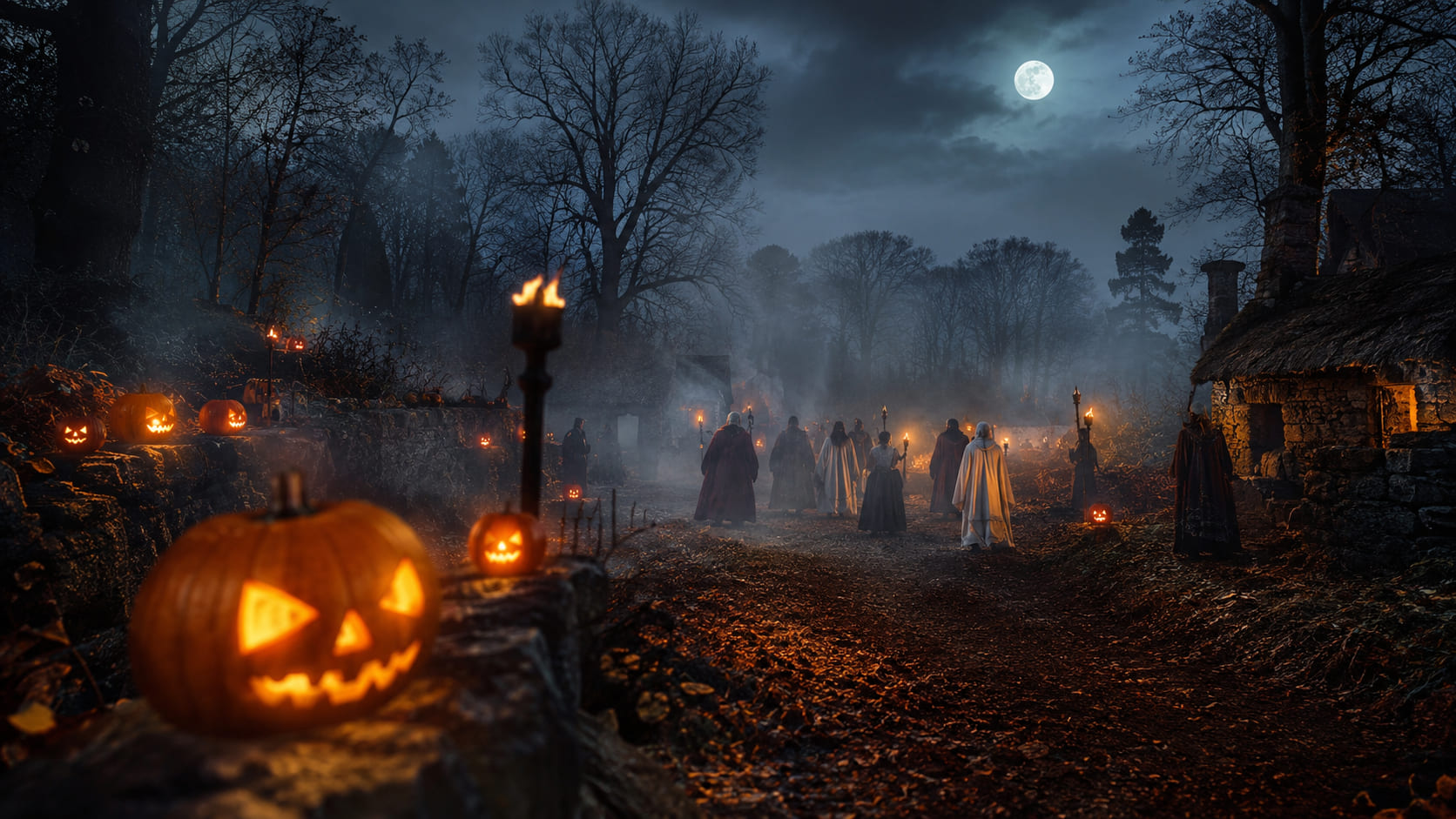
Why Halloween Became a Night for Ghosts
By late October, ghosts appear everywhere: in windows, costumes, stories, films, decorations, and supposedly haunted attractions. The connection feels so natural that it is easy to assume Halloween has always been a single ancient festival devoted to the dead. Its real history is less tidy and more interesting.
Modern Halloween developed from overlapping Christian observances, seasonal folk traditions, customs from Ireland and Scotland, migration, commercial entertainment, and centuries of storytelling. Samhain is part of that history, but the familiar claim that Halloween is simply an unchanged pagan festival surviving for two thousand years is too simplistic.
All Hallows' Eve explains the name
“Halloween” comes from All Hallows' Eve, the evening before All Saints' Day on 1 November. All Souls' Day follows on 2 November in many Christian traditions. Together, these observances created a period strongly associated with saints, the dead, remembrance, prayer, and the fate of souls.
Medieval and early modern customs varied by place. Practices included lighting candles, ringing bells, praying for the dead, and “souling,” in which people went from house to house in connection with prayers and food. These traditions changed dramatically during the Reformation and differed between Catholic and Protestant communities.
Where Samhain fits into the story
Samhain was a major seasonal festival in the Gaelic calendar, marking the transition into winter. Irish and Scottish folklore associated the period with supernatural beings, divination, seasonal danger, and unusual closeness between ordinary life and the Otherworld.
Modern Halloween clearly absorbed traditions from Celtic-speaking regions, particularly through Irish and Scottish migration. But historians caution against drawing a straight, unbroken line from one ancient ritual to every modern Halloween custom.
The historical overview of Halloween traditions and their sources reflects this mixture of Christian observance and regional folk practices. The holiday evolved rather than remaining fixed.
Why the end of harvest invited supernatural stories
Season matters. In northern Europe, late autumn brings shorter days, colder weather, dying vegetation, and the end of the agricultural cycle. Before electric lighting and modern heating, winter also meant greater isolation and practical danger.
Periods of transition often attract folklore. Boundaries between seasons become symbolic boundaries between life and death, safety and danger, home and wilderness. The idea that ordinary rules temporarily weaken is common in festivals around the world.
This does not prove that people literally believed one universal “veil between worlds” doctrine. Folklore varies enormously. It does explain why late-autumn traditions became fertile ground for stories about returning dead, fairies, spirits, omens, and divination.
Migration reshaped Halloween in North America
Irish and Scottish immigrants brought seasonal customs to North America, where they mixed with existing local traditions. Over time, Halloween became increasingly public and community-based. Costumes, parties, pranks, fortune-telling games, carved lanterns, and eventually organized trick-or-treating helped transform the holiday.
The pumpkin became especially important in North America because it was larger and easier to carve than the turnips traditionally used for lanterns in parts of Britain and Ireland. A practical change in available crops helped create one of the holiday's most recognizable symbols.
By the twentieth century, films, advertising, television, candy companies, costume manufacturers, and haunted attractions further standardized the imagery. The Halloween ghost became less tied to one religious belief and more available as a general symbol of pleasurable fear.
Ghost stories work differently when everyone agrees to be scared
Halloween creates a social permission structure for fear. On most nights, hearing that a building is haunted may invite skepticism or embarrassment. On Halloween, people actively visit haunted houses, tell frightening stories, and interpret ordinary darkness as part of the experience.
Expectation changes attention. A creak that would be ignored in July becomes interesting on 31 October. A shadow feels more meaningful after two hours of ghost stories. This is one reason seasonal paranormal investigations should document what participants already know and expect.
The same effect appears in genuinely old locations. As our article on why old buildings feel haunted explains, architecture and expectation can interact long before any unexplained event occurs.
Folklore is not failed science
It is tempting to evaluate every old ghost custom by asking whether the belief was factually correct. That misses much of its value. Folklore records how communities understood death, danger, morality, memory, and seasonal change.
A story about spirits returning home may express a continuing bond with ancestors. A warning about dangerous fairies may encode caution about isolated places. A ritual may create social order during a period associated with uncertainty. The story can matter culturally even when its supernatural claim cannot be verified.
Why ghost traditions survive modern skepticism
Modern life has not removed the emotional subjects that made these traditions powerful. People still fear death, miss the dead, enjoy controlled danger, and feel differently in darkness. Halloween packages those experiences into a shared annual event.
It also allows contradictory attitudes to coexist. Someone can wear a ghost costume without believing in ghosts. A skeptic can enjoy a séance-themed party. A believer can treat the night as spiritually meaningful. Children can experience it as a candy holiday while historians study its religious and folkloric layers.
The most accurate Halloween story is a mixed one
Halloween is neither purely pagan nor purely Christian, neither ancient and unchanged nor recently invented. It is a layered holiday shaped by centuries of religious practice, seasonal folklore, migration, entertainment, and commerce.
That complexity fits the ghosts that inhabit it. Ghost stories survive because they can be religious, psychological, historical, playful, frightening, and emotionally serious at the same time.
So when 30 October turns storefronts and homes into miniature haunted worlds, the tradition is not simply repeating one ancient belief. It is continuing a long human habit of using the darkest part of the year to think about uncertain boundaries, absent people, and the possibility that something might be waiting just beyond what we can see.