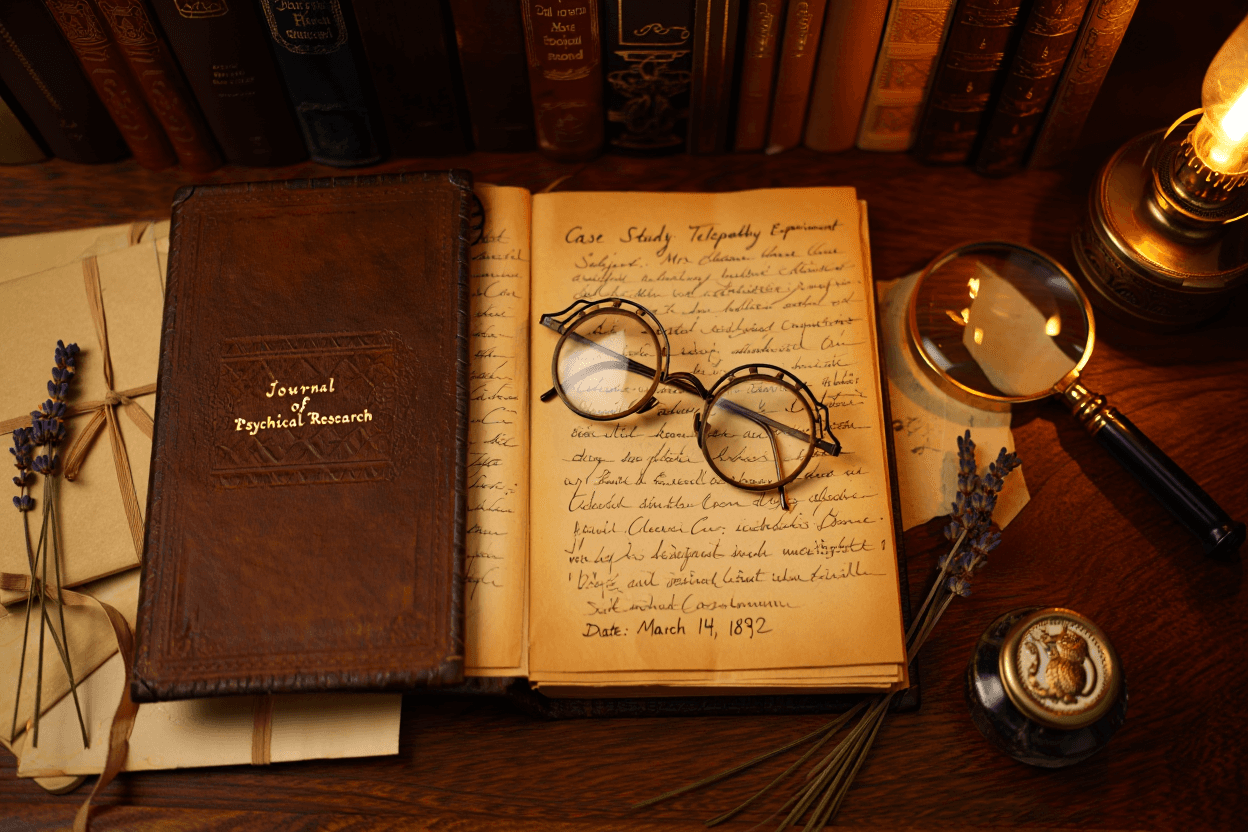
What Does Psychical Research Mean?
Psychical research is the study of experiences that people describe as psychic, paranormal, or hard to explain through ordinary senses. The term sounds old because it is old. It was used by researchers who wanted to examine telepathy, apparitions, mediumship, mesmerism, and unusual mental experiences without starting from either total belief or total dismissal.
The best place to begin is the Society for Psychical Research, often shortened to SPR. The SPR says it was founded in 1882 to investigate mesmeric, psychical, and spiritualist phenomena in a scientific spirit. That does not mean every claim became accepted science. It means the subject had people who wanted reports, tests, records, and careful debate instead of rumor alone.
This matters because many modern paranormal topics still use loose language. A ghost story, a dream that seems predictive, a claimed telepathic moment, and a séance account can all be placed under the broad heading of psychical claims. They are not the same kind of event, and they should not be judged with the same evidence. A useful blog must slow down and ask what type of claim is being made.
Psychical research also differs from casual ghost hunting. Ghost hunting often focuses on buildings, tools, recordings, and overnight investigations. Psychical research has usually paid more attention to human testimony, perception, memory, unusual mental states, and controlled tests. The two areas overlap, but they are not identical.
A simple example is telepathy. Britannica defines extrasensory perception as perception that occurs independently of known sensory processes, with telepathy, clairvoyance, and precognition usually placed in that category. A serious article about telepathy should explain the claim, describe how people say it happens, note historical experiments, and then discuss why mainstream science remains unconvinced.
The same balanced method works for apparitions. Some witnesses describe figures, voices, or a feeling of presence. A poor article would announce that spirits have been proved. A better article would ask when the report happened, who recorded it, what conditions were present, whether sleep, grief, fear, or environmental factors may have played a role, and what details remain hard to explain.
That is the editorial position of Psychical Explorers. The site can treat unusual stories with respect, but respect does not require weak evidence. Many people report strange experiences sincerely. Sincere reports still need context, comparison, and careful wording.
For readers, psychical research is useful because it offers a middle path. You do not have to mock every strange account, and you do not have to accept every claim. You can ask better questions. What exactly was experienced? What was recorded? What could be checked? What remains unknown?
This blog will use that method across ghosts, hauntings, UFOs, cryptids, folklore, sleep experiences, and older psychical cases. The goal is clear: explain strange claims in plain language while keeping the difference between story, belief, and evidence in view.
A useful habit is to rank claims by strength. A personal story is a starting point. A dated report with independent witnesses is stronger. A recording with clear chain of custody is stronger again. Each step should reduce guesswork.
Sources consulted: Society for Psychical Research history and Britannica on extrasensory perception.